The Claife Crier
A Cumbrian legend which inspired the novel
The western shores of Windermere, near the car ferry crossing, are home to the ghostly legend of the Claife Crier.
For more than 500 years, a ferry has carried people between the eastern and western shores of Windermere. What began as a simple crossing by rowing boat has evolved into the car ferry used today. It is on the quieter western shore that one of the Lake District’s most haunting legends is said to have originated.
The tale of the Claife Crier inspired my novel, The Mereland Chronicles: The Crier, which explores the events that might have taken place before the ghostly legend began. While not a ghost story itself, the novel weaves historical mystery, desire and deception into a possible origin for the haunting.
Below is my retelling of the Claife Crier legend, told from the perspective of The Mereland Chronicles.
Discover more about The Mereland Chronicles: The Crier
The Claife Crier – A Short Story
George perched on the eastern pier, his legs dangling above the water. With a high volume of passengers today, the ferry had made many trips across the chilly waters of Windermere. Now, the sun was setting behind the western hills, known as Claife Heights, on the opposite side of the mere. The orange and red hues shimmered across the mirror-like waters.
George ran his hands up and down his arms. Three months of rowing daily had built up his muscles, and the blisters on his hands had hardened into thick calluses.
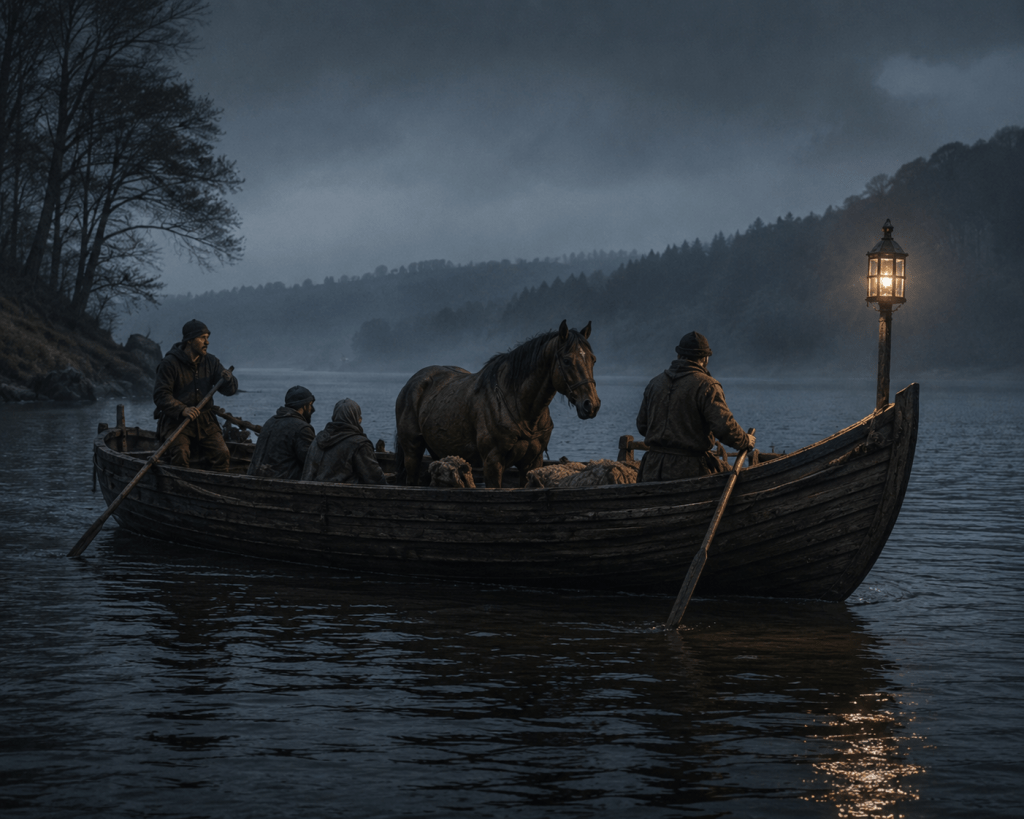
“Perhaps I should dock your wages, lad,” said Fred with a chuckle as he appeared behind him. “You seem to spend most of your day admiring yourself. Best get ready to cast off.”
George glanced at his mentor and then at the empty dock, expecting to see yet more passengers. There were none.
“We’re calling it a day then, Fred?”
“Aye, lad. I think we’ve earned our keep today. If anyone needs a ride after dark, they can call across the water. Everyone knows there’s always a ferryman or two frequenting the inn until well after dark.”
George smiled with relief. Today had been hot, making rowing the large wooden ferry much harder. The passengers were a typical mix: travellers, shepherds with their livestock, and even some monks.
“I’ll buy you an ale when we land at the Claife side.”
“I won’t argue with you there!” said George.
“You’ve done well today, lad. How’s the arms?”
“Not too bad. Getting stronger, I reckon,” said George, flexing himself.
Fred laughed. “We ferrymen are built of sturdy stuff. Have to be. I was about your age when I rowed my first passengers. Best job in the world.”
George grinned. “Give me a few weeks and I’ll race you across.”
“Ah, the apprentice likes a wager, does he? Done! And the loser buys the ale for a week. Deal?”
“Deal!” George replied. He knew his youth gave him an advantage, but Fred had years of experience rowing across this stretch of water. Even so, George never backed down to a challenge.
Fred studied the sky. “I have a feeling we might get some weather soon.”
“Why do you say that? Looks clear to me.”
“Forty years of experience, son. We’ll be feeling the breeze soon and probably closely followed by rain… and maybe the Crier.”
“The what?”
Fred scoffed. “You’ve never heard the tale of the Claife Crier?”
“No. Don’t forget I’ve only lived here a short time.”
Fred stroked his thick beard. “Oh yes, you’re from down south,” he chuckled. “I bet you wouldn’t care for a scary tale being from those parts.”
George rolled his eyes, ignoring the taunt. “So what’s so scary about this… Claife Crier?”
Fred sat down beside him and began loading his pipe with tobacco. “Well, lad, it’s a ghostly tale. I fear your mother won’t thank me if you are up all night with nightmares.”
George couldn’t quite tell if his senior was being serious or not. “I’m seventeen! Not scared of anything, me.”
Fred’s beard masked his smile. “Alright then, if you’re sure. The tale goes back a hundred years. It tells of a monk from Furness Abbey. You’ve heard of it?”
“Yes. It’s a ruin now, isn’t it?”
“That be true. Burnt down by the King’s men. Too bad. Anyway, the monk had his eye turned by a beautiful young woman. The story goes she washed up on the sands of Morecambe Bay, a presumed victim of a shipwreck. But no wreck was ever found. Soldiers found her and brought her to the Abbey, where the monk nursed her back to health. They say she could turn the head of any man.”
“Even a monk?”
“Apparently so. Eventually, she left to work in Claife. The monk, who by this time was completely captivated by her, snuck away from Furness Abbey and journeyed in secret to be reunited with his beloved.”
“Why in secret?”
“It’s likely that a monk’s decision to leave the Abbey for love wouldn’t have been something he’d openly share. Being caught would probably invite some sort of punishment. Probably for them both.”
“I suppose. So what then?” said George impatiently.
“Upon his arrival in Claife, he proposed marriage to her, but she spurned his offer and sent him away. The poor fellow had lost everything by pursuing the illusion of love. He’d lost the girl and he lost his faith… so they say. He fled up to Claife Heights, and such was his agony at losing the woman he loved, he screamed and wailed from those very hilltops.”
He paused and nodded towards Claife Heights whilst lighting his pipe. George followed his gaze thoughtfully. After inhaling the tobacco smoke, Fred savoured it for a moment, then released it before continuing. “No matter how much he yearned for her and called her name, she never came. It’s said that the heartbroken monk wandered Claife Heights, not eating, not drinking, and eventually died,” he said before taking another long drag on the pipe.
“So he died, and the wailing stopped?”
“No, lad. They say even after the monk’s death, such was the torment in his soul that his spirit continues to search for the love he lost. In the hottest summers, when a storm approaches, his wails can be heard across the water as night falls.”
“Crying for his beloved?”
“Sometimes, but sometimes the spirit calls for the ferry. If you hear it, and you will, it will chill you to the bone.”
George scoffed. “So I suppose you’ve heard the Crier’s wailing?”
“That I have, boy, and I’d advise not to be on the western dock at dusk when a storm rolls in. If you dawdle and the fog catches you, it’s too late. Your only chance is to get to the inn. For some reason the Crier won’t enter there.”
George laughed nervously. “You’re having me on!”
“Believe me, boy. If you get caught out when the Crier comes, get to the inn and stay put. And above all, never answer a call for the ferry under those circumstances.”
George swallowed. “Has anyone done that? I mean, answered the call from the Crier?”
“So they say. A hundred years ago, around the time the Crier first appeared. The ferrymen answered the call. They didn’t know the danger back then. It’s said the ferry disappeared into the mysterious fog as darkness fell and the men were never seen again. In the morning, the ferry was found floating just off the pier. One man was missing. The other had descended into madness; talking gibberish and staring wide-eyed at something that wasn’t there. It took six men to drag him from the ferry. He died a day later of terror, so they say. Since then, no ferryman has risked it.”
“But what if it’s a real passenger?”
“Then God be with them. If they are on the Claife side, they should seek shelter in the inn.”
George’s complexion had gone noticeably pale.
Fred grinned. “You alright, boy? You look spooked.”
George straightened his back. “No, erm. It’s a stupid story. I don’t believe in spirits and ghosts. You say the cry happens before a storm, it’s probably just the wind blowing through the hills.”
“Well, you better hope so, boy. But either way, heed my warning.”
“It’s poppycock. If I hear a call from the ferry and I’m on shift, I’m going to answer it.”
“I hope you’re right, boy. But I tell you now, I won’t be rowing with you. There’s a time to be brave, and that won’t be one of them.” With a shiver, he drew on his pipe, his gaze fixed on the western shore and the Claife hills forming a silhouette behind. “Come on, it’s getting dark; let’s get an ale. Untie the boat and light the lantern. I’ll be back in a minute. Nature calls.”
***
A breeze touched the mere, sending faint ripples towards where George fumbled with the mooring rope under the illumination of the oil lantern. It reached him and ruffled his hair. He looked west at the dark shapes of Claife Heights. It was unusual to feel such a chilly breeze in midsummer.
He called over his shoulder, “You were right, Fred, the weather looks like—”
Before he could finish, a frightening sound from the opposite shore cut him off. It was like nothing he’d heard before. A cry. A scream. A wail. Animal or human, it was impossible to say. George turned, but his mentor was nowhere to be seen. An icy shiver ran down his spine as he stood staring at the opposite bank, listening intently.
“It’s the bloody wind, Fred,” he whispered to himself. “Stupid old fool.”
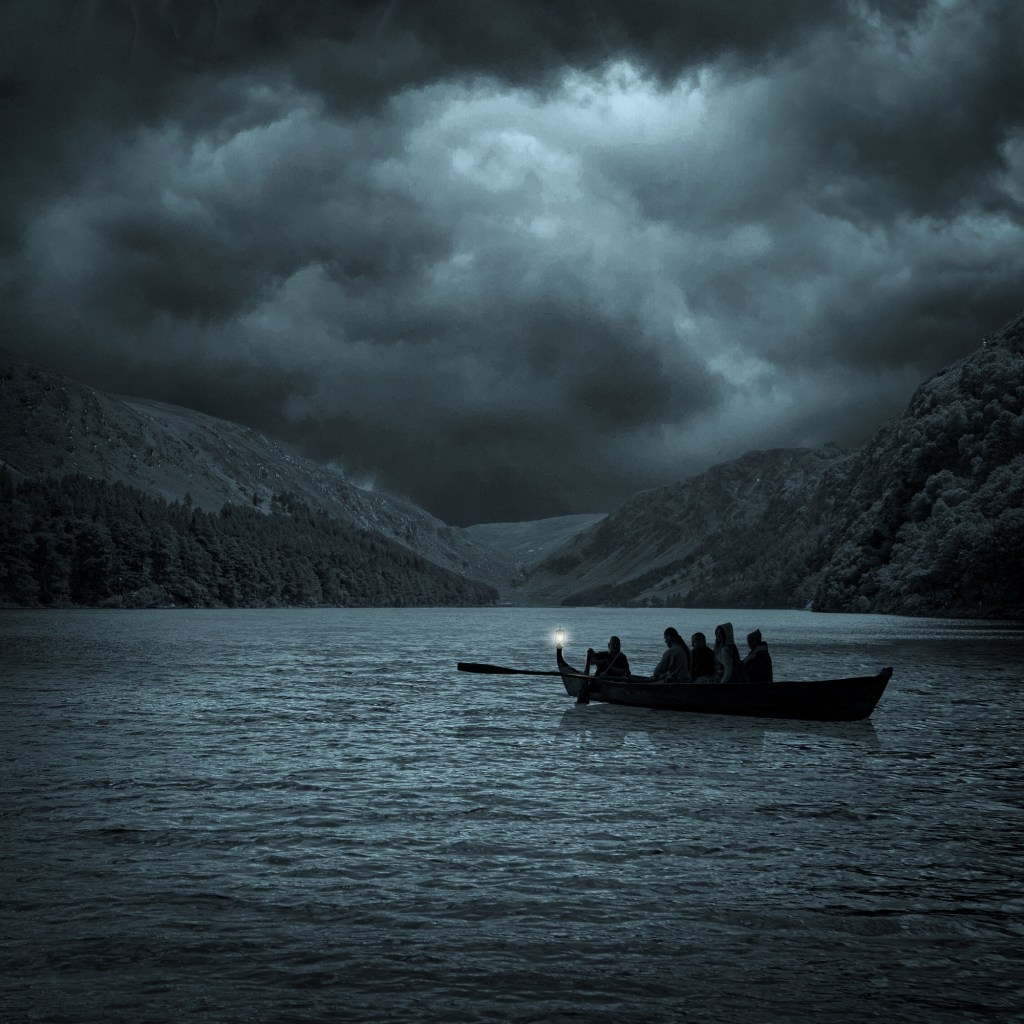
The sound came again, carried on another icy blast. The tone had changed. It was clearer this time. A pleading voice. Somehow hypnotic. George tilted his head, struggling to make out the words whispered on the breeze.
“Ferry mannn… Ferry mannn…”
“It’s a passenger. It has to be. I’ll show them all this Crier is nothing but an old wives’ tale.”
Quickly, he finished untying the craft before casting off. It would be difficult to row on his own, but not impossible if he used the oar extensions, designed to aid a one-man crossing. He got his rhythm quickly, as he pulled on the heavy oars. The ferry slid away from the eastern dock.
A third of the way across, George heard shouting. “Boy! What in God’s name are you doing?” Fred had appeared on the dock and was waving wildly. “Come back, you fool.”
“I’ll be back over with the passenger in no time, Fred,” George replied. “I’ll prove to you there is no such thing as ghosts.”
“No, boy. Get back here now!”
George rowed harder, and the boat began to move faster. He found that rowing alone was surprisingly easy, as if some unseen force were pulling the boat. Fred was now surrounded by a small crowd, drawn by the commotion. The warm glow of the lanterns they held flickered and danced along the pier as the last rays of daylight faded.
George was well over halfway across when he heard the call again. It was louder this time, much louder. The sheer volume made him flinch, as though the sound were reverberating within his head. He spun around to face Claife, almost dropping the oars into the water as he did. The western pier was dark and appeared deserted. No one was in sight, and no lights were visible, except for a faint glimmer from the inn, a short distance from the shore. A feeling of foreboding filled him.
“Maybe this isn’t such a good idea,” he thought as he yanked on an oar to turn the ferry. But despite his efforts, its course remained unchanged. He tried again, using every ounce of strength. Again the craft remained on course. As he inhaled to shout for help, his skin prickled; an icy blanket of frigid air had wrapped around him, seizing his breath. The scene of salvation from the eastern shore faded before his eyes as dense fog enveloped him; the warming glow of the lanterns dissolved, as did Fred’s calls. George shivered, his eyes darting back and forth, trying to pick out any detail or landmark. But all he could see was the cold grey fog.
Then, without warning, the boat stopped dead, the sudden jolt throwing George astern.
***
George’s eyes flicked open. He was uncertain whether he had lost consciousness, but blood from a head injury suggested he had. The freezing fog still surrounded him, and his body shivered uncontrollably. There was no sound, no smell. He raised his hands in front of his face, but at arm’s length they were invisible. Not even the familiar smell of pine from the nearby forest could breach this dense wall.
A sudden sound gave him a start.
Wood knocking against wood in rhythm with the rocking of the boat. “The pier,” he whispered to himself. “Stupid. It’s just the boat knocking against the pier.”
Crawling forward into the gloom, his hand soon met the solid structure. Quickly, he secured the mooring line before stepping onto the silent pier. Hesitantly, he shuffled forward towards the shore. He had walked this boardwalk countless times, yet the lack of sensory cues forced him to move at a snail’s pace, using his feet to feel the way. Even his footsteps on the wooden boards and the familiar creaking of the pier under his weight seemed muted.
Usually, this place would bustle with people; some waiting to cross the mere, others heading to the inn, or passing through on the north-south road that stretched the length of Windermere. The unusual stillness was eerie. Unnatural.
He muttered, attempting to anchor himself, “Stupid old folk. This is just weather.”
Tentatively standing tall, he took a breath and called, “The ferry is here. Who seeks the far shore?”
Silence. Nothing. Even the sound of his own voice felt muffled.

Taking a step forward, he tried again, calling into the fog. “Who seeks the far shore?”
He strained his ears, but no reply came.
“Sod this. I’ve proven there’s nothing here,” he muttered. “I can’t wait to see the look on old Fred’s face when I show him it’s all just superstition.”
He turned towards the boat and took a single step.
Then stopped.
Behind him, he heard the unmistakable sound of heavy breathing; the breath felt icy on his nape, sending a creeping sensation down his spine. George spun around, but all that greeted him was empty, cold fog.
“Is… is anyone there?”
No answer came.
Then, a sound drifted through the fog. The sound of a grown man sobbing. His eye caught a shadow as it appeared from the gloom. A dark, hooded figure.
George forced himself to speak, “Hello. Are you alright?”
The sobbing stopped and there was silence again. The mist swirled and the figure vanished.
George screamed and lurched toward the ferry, too afraid to look back. As he did, the silence broke, and an ear-piercing wail filled the air. The shriek pierced his skull, flooding his mind with impressions of grief that were not his own. Sorrow, pain, loss. So intense that they enveloped George’s very being. He dropped to his knees, paralysed, unable to think as the raw emotion tore through him. He slammed his hands against his ears and clenched his eyes shut, but nothing stopped the bombardment.
Then, as quickly as it came, the sound ceased.
Shivering and afraid, he opened his eyes. He was alone on the pier again.
Aware of the vice-like pressure against his ears, he relaxed his arms. Before him, the silent grey fog.
A tear ran down his cheek, followed by another. George wiped them away.
“What’s wrong with me?”
A wave of emotion overwhelmed him, and he collapsed onto the deck, sobbing. His heart felt empty, though he didn’t know why.
George heard a noise behind him but paid it no mind. The ache of sorrow in his heart was all that mattered to him now.
The fog swirled.
A shadow.
A figure.
A moment of pain, then darkness.
***
Fred looked crestfallen. “I should have stopped him.”
“You know what young’uns can be like. Think they know better. That experience doesn’t count,” said someone behind him.
“Who’s going after him?” said another.
A murmur rippled through the crowd, but no one volunteered.
“What’s that! Look.”
“What. Can’t see nowt,” said Fred, raising his lantern higher and scanning the dark surface of the mere.
“It’s the wake of a boat. I’m sure of it. Look there!”
“Lord Almighty, it’s the ferry!” said Fred. “But… no one’s rowing. How can it be moving?”
The crowd watched in silence as the ferryboat returned. It glided almost silently, the only sound a faint, eerie lapping of water against the hull. As it approached the pier, the crowd nervously retreated to the safety of the shore.
Reaching the beach, the ferry slid to a halt on the shingle.
For a moment, the crowd stared, not sure what to do, until someone nudged Fred’s shoulder. “Go and look.”
Fred straightened himself and made his way to the vessel, lanterns casting uneasy shadows, two men at his back. Nearing the ferry, a faint whimper froze them in their tracks.
“George,” Fred whispered. “Are you there, lad?”
No answer, only a soft moan. Peering into the dark hull, the men gasped. George lay curled in a tight ball, trembling, his head buried beneath clenched arms.
“George. You alright, lad?” he said, reaching out and touching the boy’s shoulder. “Blimey, he’s cold. Cold as ice!”
Suddenly, George flinched, his head snapping towards Fred with unnatural speed, his eyes brimming with terror yet disturbingly hollow.
Fred frowned. “You alright, lad?”
George opened his mouth, but the words that came were gibberish. The men looked at each other, bewildered. Then George’s rambling stopped, and he wept. Through his broken words, one phrase emerged clearly. “I lost her. I lost my love.”
George’s face twisted in agony.
“Hann—”
His body convulsed.
His eyes rolled back in his head, and he collapsed.
Fred carefully knelt next to his apprentice and examined him.
One man nodded toward the dark shape of the island to the north. “Should I call for a healer monk from the monastery on Lady Holme Island?”
Fred didn’t reply. Then slowly he turned to face the men. “No point. The lad is dead.”
“What was he trying to say?”
Fred stroked his beard and said, “I have no idea.”
About the Claife Crier
The Claife Crier is a traditional Lake District ghost story associated with Claife Heights and Windermere. This version reimagines the famous Cumbrian folklore tale within the universe of The Mereland Chronicles: The Crier, a historical mystery novel inspired by the Claife Crier legend, exploring events that may have led to the tale told in local folklore.
The Real Claife Crier Legend
The Claife Crier, sometimes known as The Crier of Claife, is one of the lesser-known stories of Lake District folklore. According to local tradition, the spirit of a heartbroken monk can sometimes be heard crying out from Claife Heights across Windermere. The earliest known published version of the legend appeared in the Kendal Mercury on 25 December 1852, before later being recorded by Harriet Martineau in A Complete Guide to the English Lakes (1855). Over time, the tale became part of Cumbria’s rich heritage of ghost stories and local legends.
The Claife Crier in The Mereland Chronicles
In The Mereland Chronicles: The Crier, the Claife Crier legend plays an important role in the wider mystery surrounding Windermere, Claife Heights, and the people who live in their shadow.
This retelling was originally written for inclusion in The Mereland Chronicles: The Crier. Although it did not make the final version of the novel, I have dusted off this unpublished story and shared it here for readers to enjoy. Readers of The Mereland Chronicles may spot a few familiar references and Easter eggs hidden within the tale.
Interested in the wider mystery behind the legend? Explore The Mereland Chronicles: The Crier, a historical mystery novel inspired by the Claife Crier, Windermere folklore, and the landscapes of the Lake District.